Moon sign, Sun sign or Lagna? How to find your rashi
A Moon sign calculator and a Lagna calculator can give you different signs for the same birth. Learn what each measures and how to check a borderline result.
Editorial review:
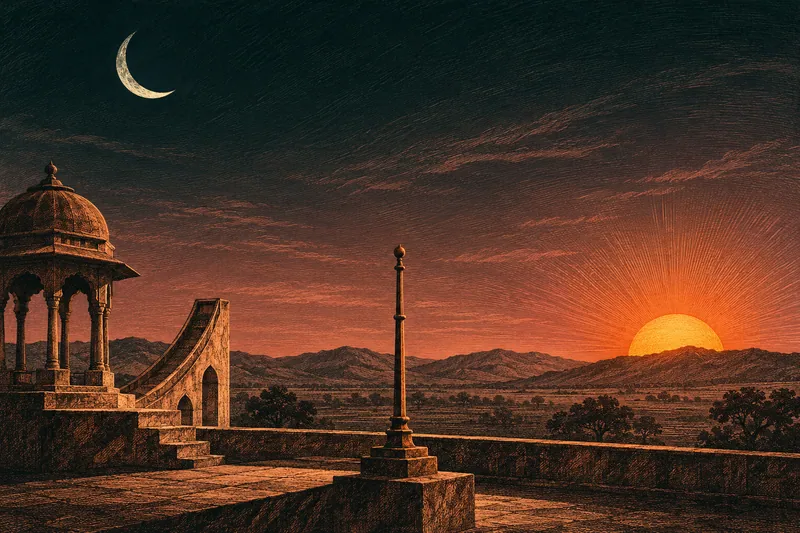
One birthday can have three sign names
Perhaps a relative calls you Karka, a birthday column calls you Simha and your Kundli opens with Tula. Before choosing which name to use, look for the word beside each one. Chandra means Moon, Surya means Sun, and Lagna means the ascendant. In a single sidereal chart the Moon could be in Cancer, the Sun in Leo and Libra rising. All three entries describe the same birth from different reference points.
How a Moon sign calculator finds Janma Rashi
Rashi is the general word for a zodiac sign. In a family conversation about Janma Rashi, it usually means the sign occupied by the Moon at birth. A calculator finds the Moon’s position for that instant and checks which of the twelve 30-degree divisions contains it. The Moon spends roughly two and a quarter days in a sign on average. It can cross into another sign during the same calendar date.
The Sun moves across about one sign per month. Many birthday columns use the tropical zodiac, which starts at the March equinox. A Vedic calculator commonly uses a sidereal zodiac. Check the zodiac setting before comparing Sun signs across websites. Even two sidereal tools can use different ayanamshas, the offsets that relate the two zodiac systems.
Why a Lagna calculator asks for the town
Picture standing at the birthplace and facing east. The rising point is where the zodiac’s path meets the eastern horizon at that moment. Its sign is Lagna. As Earth turns, another part of the zodiac rises. Two people born at the same instant in different cities can therefore have different ascendants. Rising times also vary with latitude and sign. Adding a fixed two hours per sign will give only a rough guess.
Check a birth time near a boundary
Suppose a family remembers a birth as “between eight and half past eight.” Enter the correct town, date and local time zone, then draw one chart for each end of that interval. Compare the Moon’s degree and the ascendant in both. If the Moon stays in Cancer but the ascendant passes from Libra into Scorpio, you can record Cancer with confidence for that interval and keep both possible Lagnas on the page.
Which sign should you use next? If a rashifal asks for your Chandra Rashi, choose Cancer in that example. If a lesson asks you to count houses from Lagna, use the confirmed rising sign. The label on the reading tells you which of the three positions to bring to it.
Can you find your rashi by date of birth alone?
Suppose a family record gives your birth date and names Jaipur as your birthplace, but the space for the time is blank. Look up the Moon at the start and end of that local date in a sidereal ephemeris, a table of planetary positions. If the Moon starts in the middle of Cancer and is still in Cancer at the end, you can use Cancer as your Janma Rashi for that day. Identifying the rising sign still requires a birth time.
Now try a different set of sample positions. The Moon begins the date at 28° Gemini and finishes at 11° Cancer. Find the time it enters Cancer in the local Panchang. A birth before that time gives a Gemini Moon, and a birth after it gives a Cancer Moon. A note such as “before breakfast” helps only if it places the birth on one side of that change. Until then, keep both possibilities in your notes.
How to create a Kundli by date of birth, time and placeKeep your curiosity going.
All stories ↗
How to read the 12 houses in a Vedic birth chart
Follow a Taurus rising example around a North Indian Kundli. Find the houses, decode the sign numbers and read one planet in its place.
Numerology by date of birth: your Mulank and life path number
Use one birthday to calculate a birth number and a full-date number, then see why one numerology calculator might show 11 and another 2.