Amavasya and Purnima in the Hindu lunar month
Read Amavasya and Purnima in the Hindu calendar. Learn how the two pakshas work, when each tithi ends and why a local observance can fall on a different date.
Editorial review:
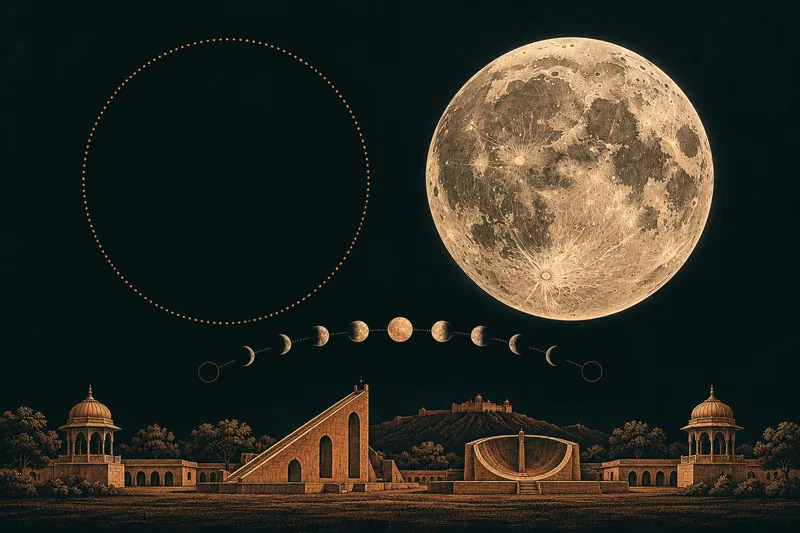
Follow the Moon for one month
A nearly round Moon hangs above the terrace on Monday, yet the calendar marks Purnima on Tuesday. Both make sense. The Moon can look full to the eye on neighbouring nights. A Panchang follows a measurable change in the Moon’s position relative to the Sun. That gives the calendar a precise boundary even when the view from your terrace changes very little.
From one new Moon to the next takes about 29½ days on average. The waxing half is Shukla Paksha. Follow it from Shukla Pratipada to Purnima. The waning half is Krishna Paksha. Follow it from Krishna Pratipada to Amavasya. Each half has fifteen tithis. Pratipada is the first one in either half, so keep the paksha name when you write down a tithi.
One tithi has a start and an end
Imagine travelling along the zodiac from the Sun’s position towards the Moon in the direction of increasing longitude. Every additional 12° of separation completes one tithi. The time this takes varies with the Moon’s motion. At 168° the last tithi of Shukla Paksha begins. At 180° comes the exact full Moon, Purnima tithi ends, and Krishna Pratipada begins. On the way back to new Moon, Amavasya tithi starts at 348°. It ends when the separation completes 360° and starts again from zero.
Follow a lunar month: November to December 2026
Open the calendar for Delhi, using Indian Standard Time. The new Moon falls around 12:32 PM on 9 November 2026. That is where Amavasya ends and the waxing half begins. Follow it to the full Moon at about 8:23 PM on 24 November. The Moon then wanes until the next new Moon, around 6:22 AM on 9 December. These three times mark boundaries; they do not tell you when a family should begin a fast.
Now compare two births in Delhi on 24 November. At 7:45 PM the birth tithi is still Purnima. By 8:45 PM it is Krishna Pratipada, even though the Moon looks round to both families. If you only copy the label printed at the top of that day’s calendar square, you lose the distinction.
Why Ekadashi can span two dates in today’s PanchangWhich city and which date should you use?
The astronomical phase happens at one instant worldwide. If it is Tuesday at 8:15 PM UTC, it is already Wednesday at 1:45 AM in India. For a birth, use the recorded local date, time and birthplace. For an observance, choose the city where you will observe it. Local sunrise and the time of day used by your particular festival tradition can affect which civil date is marked.
You may also see different month names in two family calendars. An Amanta month ends at new Moon, while a Purnimanta month ends at full Moon. To compare entries, first check the city, paksha, tithi and its end time. Then read the month name according to the family calendar you follow. Those four details are a much clearer starting point than a Moon icon alone.
Keep your curiosity going.
All stories ↗
Jupiter and Saturn transits from your Lagna and Moon sign
Find which houses Jupiter and Saturn transit in your Kundli. A single example shows how to count from the ascendant and birth Moon and read both results.
How to read a Griha Pravesh muhurat for your new home
Use the new home’s city, read a window that crosses midnight, and work out when to invite your family. A published Pune example shows how.