How to read current planetary positions and compare a transit
Read current planetary positions by sign and degree, spot a retrograde planet and compare a Jupiter transit from your Lagna and birth Moon.
Editorial review:
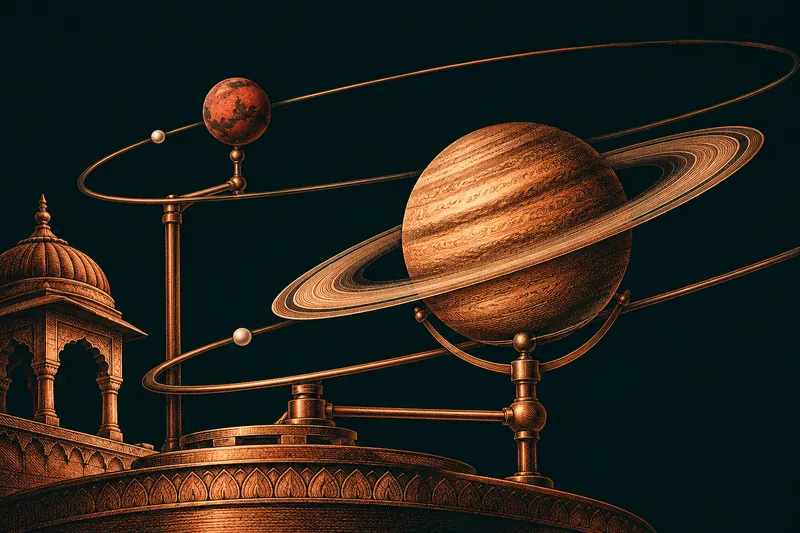
What does a line such as “Jupiter, Taurus, 8°20′” tell you?
Think of the zodiac as a measuring circle. Its twelve signs take up 30 degrees apiece. In an illustrative position table, “Jupiter, Taurus, 8°20′” places Jupiter eight degrees and twenty arcminutes into Taurus. Sixty arcminutes make a degree. The small prime mark measures part of an angle, even though people call it a minute. It tells you nothing about the time on a clock.
Count from the start of Aries instead and the same position reads 38°20′, because Taurus begins at 30°. If one table uses a full-circle number and another gives degrees within the sign, both can describe exactly the same point. At 30° beyond the start of Taurus you reach 0° Gemini. This is what a change of sign, or ingress, looks like in the numbers.
Which moment does the table describe?
A birth position belongs to the moment a person was born. A transit position belongs to the moment chosen for comparison. The word “current” only becomes precise when you know the date, clock time and time zone. A screenshot shared yesterday still has yesterday’s positions. If you reopen a chart to compare the two, keep your birth details in place and change the viewing date of the transit.
Check whether both displays use a sidereal (nirayana) or tropical (sayana) zodiac. These systems use different starting points. For a sidereal comparison, also use the same ayanamsha, the convention that sets the offset. If two websites give different signs near a boundary, these settings are worth checking before trying to interpret the difference.
Compare Jupiter with a birth Moon
In a practice chart, put the birth Moon at 10°05′ Taurus and transiting Jupiter at 8°20′ Taurus. They share a sign. To see how near they are along the zodiac, rewrite 10°05′ as 9°65′ and subtract 8°20′. The gap is 1°45′. A second person with a birth Moon at 26°20′ Taurus also has Jupiter in the Moon’s sign, but the gap is 18°. A sign-level reading treats both as the same placement. The degree column tells a different part of each person’s story.
To find out whether the gap is shrinking, compare Jupiter’s position again at a later time with the same settings. A single row gives its position at one moment. The comparison supplies a precise observation for a traditional reading. The numbers alone cannot tell you what will happen in someone’s work or family life.
Jupiter and Saturn transits from your Lagna and Moon signWhat a retrograde mark adds
An R or ℞ indicates retrograde motion. Seen from Earth, a planet can appear to move back across the background sky while both Earth and the planet keep orbiting the Sun. With Mars, this is easy to picture when Earth overtakes it. On Cospyria’s Cosmic Clock, select a planet, read its sign and degree, and look at its motion label. Record the time alongside them. When you return, you can compare two observations of your own.
Which house is Jupiter transiting in your chart?
Keep the example of Jupiter transiting Taurus. Give the person a Leo Lagna and a Taurus birth Moon. In a whole-sign Lagna chart, count Leo as one, Virgo as two and continue around to Taurus. Taurus is the tenth house from Leo. In a Moon chart, start again with Taurus as one. The same Jupiter transit is now in the first house from the Moon. The position table still reads Taurus in both cases.
Try writing the reference next to the house number when you save a transit observation. “Jupiter in house ten from Lagna” tells a reader why you opened the section on work and public responsibilities. “Jupiter in the Moon’s sign” tells them why you compared the degrees of Jupiter and your birth Moon. You can now retrace both readings from one entry in the table.
How to read the 12 houses in a Vedic birth chartKeep your curiosity going.
All stories ↗
How to read D1, Navamsa and transit charts in Cospyria
Follow Venus from D1 into a Navamsa chart, find a planet in Positions and check which date you are reading in a transit chart.
Amavasya and Purnima in the Hindu lunar month
Read Amavasya and Purnima in the Hindu calendar. Learn how the two pakshas work, when each tithi ends and why a local observance can fall on a different date.