How to use the Vedic calendar and daily Panchang together
Use the Vedic calendar to find a date, the daily Panchang to check its tithi and Muhurat to look up the hora. Follow an evening example from Bhopal.
Editorial review:
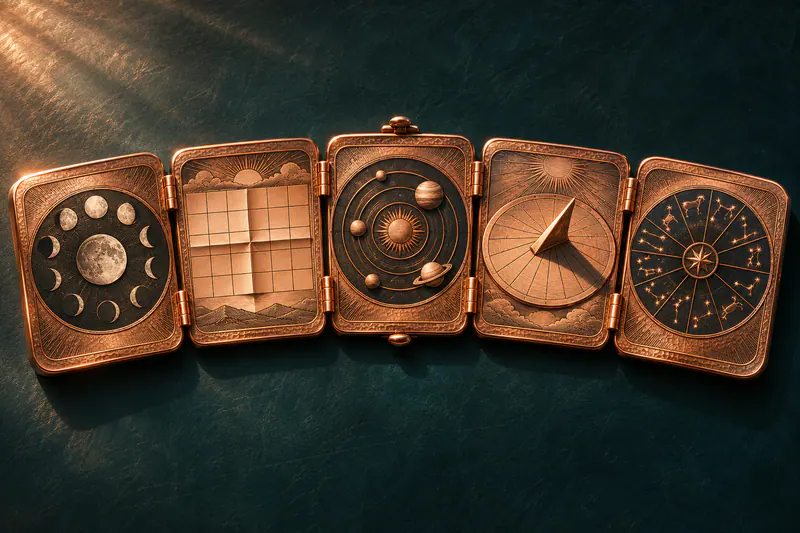
A calendar is the overview
Begin with Vedic Calendar when your question is about a date or an observance. Choose a day to see its detail rather than assuming that everything shown in a date cell lasts for the full civil day. A tithi can begin or end partway through it.
Open Panchang to look more closely at the day’s elements and timings. The selected location matters for local sunrise and the presentation of time windows. Check it before comparing a result with a calendar for another city.
The clock makes positions visible
The Cosmic Clock is a way to explore planetary positions. Select a planet and read its detail panel. The surrounding zodiac, nakshatra and pada rings help you locate the named segment around the full circle.
Treat the clock as an instrument to inspect, not just a picture to admire. A selected planet, its displayed time and its coordinates provide more information than judging the arrangement by eye.
Timing and interpretation answer different questions
Muhurat lets you inspect the available daily time windows and planetary hours. Rashifal offers a sign-based reading. A general sign reading is broader than a personal reading built from your own birth chart.
There is no need to open everything at once. Choose a date in the calendar, inspect its Panchang, or spend a moment with one planet on the clock. A small, clear question often makes a better first discovery than trying to understand the whole sky in one sitting.
Which tool answers a question about tonight?
Suppose your family in Bhopal is planning to read together at 7 PM. One person asks which tithi will be running then. Choose Bhopal in the daily Panchang and compare 7 PM with the listed ending time. If the current tithi ends at 6:40 PM in your practice example, read the next tithi for the gathering. The morning’s label alone would give the family the wrong answer.
Someone else asks which planet rules that hour. Keep the same date and city, open Muhurat and find the hora interval containing 7 PM. Write the tithi and hora lord on separate lines. You have answered two different questions about the same gathering.
Why Ekadashi can span two dates in today’s PanchangWork out one planetary hour
For a separate practice example, suppose it is Sunday, sunrise is 6:00 AM and sunset is 6:30 PM. The daylight lasts 750 minutes. Dividing it into twelve gives a daytime hora of 62 minutes and 30 seconds. The first hora belongs to Sunday's lord, the Sun. Venus follows, then Mercury. At 8:30 AM you would be inside Mercury's interval in the table below.
Night horas are calculated separately from sunset to the next sunrise, so do not keep adding the daytime duration after sunset. The planetary sequence continues through the night. At the exact start of a new interval, use its new ruler: 8:05 AM in this example belongs to Mercury. These invented sunrise and sunset times teach the method; use the actual selected city's timings for a real day.
| Hora lord | Start | End |
|---|---|---|
| Sun | 6:00:00 AM | 7:02:30 AM |
| Venus | 7:02:30 AM | 8:05:00 AM |
| Mercury | 8:05:00 AM | 9:07:30 AM |
Keep one clear daily note
Write four things before sending a timing to someone else: the city, the civil date, the start and end, and the activity you mean. A useful note might read “Bhopal, our chosen date, gathering at 7 PM; check the tithi after 6:40 PM and the hora containing 7 PM.” This preserves the distinction between a family appointment and a calculated sky interval.
A favourable hora is one traditional timing consideration, not a complete assessment of a wedding, house entry or important financial decision. Check the ceremony's own rules where relevant, and keep availability, preparation and practical responsibilities in the plan. If two screens disagree, first make their date, city and timezone identical, then check whether one labels the sunrise tithi and the other the tithi at your chosen hour.
Keep your curiosity going.
All stories ↗
Amavasya and Purnima in the Hindu lunar month
Read Amavasya and Purnima in the Hindu calendar. Learn how the two pakshas work, when each tithi ends and why a local observance can fall on a different date.
Jupiter and Saturn transits from your Lagna and Moon sign
Find which houses Jupiter and Saturn transit in your Kundli. A single example shows how to count from the ascendant and birth Moon and read both results.